Editorial

"Zen teaches nothing; it merely enables us to wake up and become aware. It does not teach, it points." ~D.T. Suzuki
Showing posts with label DNA. Show all posts

Friday, February 14, 2014

Romance with the Red Queen

and by romance I mean sex...
Romance

with the 
Red Queen
'Now, here, you see, it takes all the running you can do, to keep in the same place.'
The Red Queen - Through the Looking-Glass - Lewis Carroll 
The Red Queen Hypothesis,
also referred to as
The Red Queen's Race or The Red Queen Effect,
is an evolutionary hypothesis which proposes that organisms must constantly adapt, evolve, and proliferate not merely to gain reproductive advantage, but also simply to survive while pitted against ever-evolving opposing organisms in an ever-changing environment.

(Wikipedia)
The Red Queen, like The Struggle for Life, points to constant change as the only permanent condition.
appears to provide added variability
from some of the conditions
the parents were living in.
.
Epigenetic changes the DNA
of the individual in a subtle way.
While it doesn't change
the DNA sequence,
it has, by methylationchanged 
how these genes become expressed
It seems at least some of these changes can be passed on
through from the parents DNA
to the next generations of offspring.
So...

What Does This Have To Do With Sex?

Creatures could just reproduce asexually. Bacteria have been "doing it" that way for a very long and by count, a successful time. Basically cloning themselves, with mutations and methylations providing the necessary adaptations. This appears to work extremely well for some beings, single celled entities as an abundant example, but some life forms may have succeeded with, what was for them, well, let's just say... a better way.

Very Close Friends... With Benefits
Sex provides variability.
It does this simply by
making the offspring unique. 
Varied offspring may be better adapted to current conditions. This can also confer a faster response to natural selection. 

Sex Is Better When...
In the case of  asexuals, (offspring produced by inheriting the DNA of their single parent), any parasites adapted to infect the parent should also be capable of infecting the offspring.

Sex allows parents to combine and recombine DNA thus producing offspring that are diverse and genetically different from either one of their parents. Parasites or diseases that have adapted to infect one generation may have difficulty infecting the next. So sex is a pretty good evolutionary adaptation.

Sexual Reproduction & Genetic Variability (PBS)
There are even business applications to this... ahem... proposition
Incorporating 
can be of great profit to business.


Evolution
shouldn't be a neglected science
when it comes to economics.
THE RED QUEEN EFFECT:
COMPETITIVE ACTIONS AND FIRM PERFORMANCE

"Applied to a business context, the Red Queen can be seen as a contest in which each firm’s performance depends on the firm’s matching or exceeding the actions of rivals. In these contests, performance increases gained by one firm as a result of innovative actions tend to lead to a performance decrease in other firms. The only way rival firms in such competitive races can maintain their performance relative to others is by taking actions of their own. Each firm is forced by the others in an industry to participate in continuous and escalating actions and development that are such that all the firms end up racing as fast as they can just to standstill relative to competitors. This self-escalating, coevolving system of Red Queen competition has been empirically shown to affect founding rates(Barnett & Sorenson, 2002), failure rates (Barnett &Hansen, 1996), and competitiveness (Barnett &McKendrick, 2004). Indeed, Baumol (2004) suggested that the Red Queen effect is the most powerful mechanism driving economic development in capitalistic society."

Academy of Management Journal 2008,
Vol. 51, No. 1, 61–80.
You know, we're not getting anywhere like this!
Baby, you sure we're doing it the right way?
© 2014 MU-Peter Shimon

Monday, September 23, 2013

Humanderthal

or What Are You? A Neanderthal?
Humanderthal

What Are You?

A Neanderthal?

Homo sapiens neanderthalensis
La Chapelle-aux-Saints 1
"The Old Man" 60,000 yrs. old

I was attracted to paleo-anthropology and evolutionary ecology because like most humans I wanted to know my origins. I studied the Neanderthals because they were us and yet not us. I was certainly curious how a species that managed to endure for hundreds of thousands of years became extinct. I looked at all the evidence I could get my hands on, poured over all the published arguments and discussed with others, as to what happened to the Neanderthals. Did they mix and hybridize with humans? What happened? I had to know!

Did We "Dance" With Neanderthals?

La Chapelle-aux-Saints cave
was the first discovery of a Neanderthal tomb

What I had seen, showed that their physical and cultural differences from us were VERY narrow. Had they met, would there be a barrier to mating, and if they were not too different genetically, could it have been possible to have viable hybrid offspring from this mix?

As I have researched and patiently waited the years, for the field work and science that would recover more intact Neanderthal DNA, new sequencing techniques that would build a bigger database of both the human and Neanderthal genome. All these would provide the whole Neanderthal genome and the human data that would help with the unanswered questions about the final fate of my favorite subject, our close relatives,
the Neanderthals.

What happened to the Neanderthals?

They were not dumb. They were not brutes.
And in a way they're not entirely extinct either.

Want to see a real live Neanderthal?
Look in the mirror.
This short video will explain
ALL (non-african) humans in the world today
have a genome with about 2-4 percent,
uniquely Neanderthal DNA.

So, if your ancestors were not from African, then...
You Are A Humanderthal


The Neanderthals lived for hundreds of thousands of years. They showed the first glimmers of modern behaviors such as a sophisticated stone tool culture, control of fire, hunting and gathering, caring for the infirm and elderly, and interestingly some amount of symbolic or ritual behavior including burial of the dead. These traits we consider quite human and when you learn more about them you will see that there's no shame in being Neanderthal.

There is genetic evidence that when humans came out of Africa between 80,000 and 50,000 years ago the first encounter and therefore chance for human and Neanderthal interbreeding happened in the Levant. Beyond this, it is not known if mating may have continued throughout Europe and Asia. But it seems it could have until about 35-25,000 years ago, when after this time... the Neanderthal sites, their remains and artifacts are no longer found in the archeological record.


An Excellent Presentation by Carl Zimmer
Neanderthal Facial Reconstruction 
Then as compared to Now


You see what you think you see... Compare how we used to think of Neanderthals, to what we know now. With more finds and new technologies, we realize...hey, they look a lot more like us! They didn't look like what we first thought at all. But then again, there was still a great deal we didn't know about them.

That was then. Now we have quite a bit of evidence to clear up many of the questions surrounding who the Neanderthals were, what might have happened to them, and what was their evolutionary and contemporary relationship with humans.

Over the years of research, refinement of technique and of course new finds, we have learned much about them.yet there remains so much more about them to be learned. Where they differ in genes and mutations can teach medicine more about many diseases. The further study of their genome has much to contribute to evolutionary medicine.

 They likely had language and beyond tool production and other behaviors,


Neanderthals had their own aesthetics.


The Neanderthals indeed had culture(s)
passed on from generation to generation.

One still intriguing question that new dating methods have brought up is the artists who made the cave art in Europe. Was that only a modern human trait? Or was that the innovation that came from their meeting or mating? A Cro-magnon hybrid? Why there is cave art and what is the meaning of the art is speculative at best.


At more than 40,800 years old, these dots and crimson hand stencils on the walls of a cave called El Castillo in Spain are the world's oldest cave art.

 It is the earliest time that the archeology shows humans and Neanderthals began overlapping in Western Europe roughly 45,000 years ago. 

The details of Neanderthals are fascinating.
In future posts I hope to share more of those, including details of the Neanderthal sites and the human cave art that I have excavated or visited in Southern France.
Are We Human? or Are We Dancers?
Enjoy.
© 2013 MU-Peter Shimon

Thursday, April 5, 2012

Abiogenesis

Or Just Who Do You Think You Are?
We live today.

We are the result and the continuation of a long adventurous history. Our matter, the energy/mass of our bodies was originally formed billions of years ago shortly after (relatively speaking) the universe’s explosive origin. Over eons of nuclear churning in large distant stars, the different atoms here on Earth today were forged. This fusion process continues, along with the birth, life and death of countless stars in countless galaxies. Nurseries of the elements of matter, their death throes eject those atoms into space. Casting their seeds, the fruit of their burning lives and labors far away, to perhaps mingle and join with other things. To become something else.

Some of those atoms and molecules of past novas and supernova joined in our galactic neighborhood and were part of the nebulous gases that eventually congealed into our solar system. Participating in the birth of our star...the sun. 
The Evolutionary History of Life

True, our sun is also an "alchemical" furnace and nuclear fusion is occurring there.

However, our sun is of the type and size only able to turn hydrogen (the most abundant element) into helium. This means all the other atoms in our solar system came here from other stars. Novas and supernovas long, long ago and far, far away.We are made of star stuff. Nous sommes du soleil.

The material foundation for what we recognize as LIFE on this planet is one particular molecule called DNA (Deoxyribonucleic acid). (I won’t go into RNA (Ribonucleic acid) viruses, proteins or other pre-biotic, or comet and asteroid theories for the origins of life here.)

So here we are. We are a little different from the other molecules around us because we have cellular membranes, DNA, RNA, proteins, etc. We metabolize, synthesize and reproduce. And perhaps most distinguishingly, we actively respond to our environment. Maybe it should be looked upon as a part of it, instead of apart from it?

After it had cooled considerably from its gaseous and molten state something interesting happened here on the planet Earth. Something, under those first conditions, about 3.5 to 4 billion years ago, began to have functionally organized types of molecules. Seemly going against entropy. These dead and inert molecules, collectively began taking on the characteristics we recognize as life. It all happened then, long ago and this initial birth or appearance of life on Earth has no evidence of happening again. It has not been replic ated since.
We have no evidence of any other occurrence of spontaneous abiogenesis on Earth or any where else, yet. (Hear that SETI?)

However since then there has been biogenesis. One of hallmarks of this life is reproduction, and apparently life here has been replicating itself, abundantly on this hospitable "pale blue dot". Over time, it has filled the world with the astonishingly beautiful bounty and diversity of its offspring. Life, the source of the organizing energy, itself is intangible. Whatever spark it is that animates molecules identical to other molecules that are dead, we have yet to understand it. We have yet to successfully replicate it. Dr. Frankenstein, notwithstanding, we have yet to bring dead matter to life. We can mix up all the right compounds and components, but still miss something. No spark, no ignition.

However, if we do not see the cause we do see its manifestations and characteristics. Life can perhaps started in some molecules associating and functioning in an almost orchestrated or coordinated manner. But in the Earth environment of that time it is very likely that these first chemical associations though abundant, were only short and fleeting.

Life truly manifested itself when the molecules survived in associations that, simply enough, had an outer shell (maybe a bubble of protein and/or lipids). Within a semi permeable shell, certain molecules and operations could proceed under more stable and constant conditions.
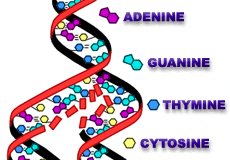
DNA

CELL

Cells that created or maintained their shell perhaps had a better chance at survival. In time, the outer shell and the internal chemistry became modified and more elaborate. Single cell life forms, those with a membrane, a reproductive mechanism and using the abundant thermal and chemical energy of  marine volcanic vents or of sunlight on the surface, flourished. These replicated in various ways including with mitosis, meiosis and recombinations of DNA, yielding descendants with variations.

The differences manifested were designed by code (recombination) and incidental events (mutational, developmental, environmental, epigenetic influences, etc), then subjected over time to the changing conditions they were naturally selected, just as they still are today.

But rewind for second. That first spark didn't really die, did it? It reproduced itself over and over again through the countless years. Continuously flowing life. Reproduction into the future. Descent with modification, on and on... In science we call this process of change in life forms, evolution.

Ok, so here's the finger pointing at the moon...

That first life is still here on this planet
It's still alive today

That original spark
 is all the life around you

It's in you...

 It is you.

Science Shows Us
We Are One Life
Do we really have to continue to do this?
Carl Sagan - 1966 Interview on Astrobiology
Enjoy.
© 2012 MU-Peter Shimon